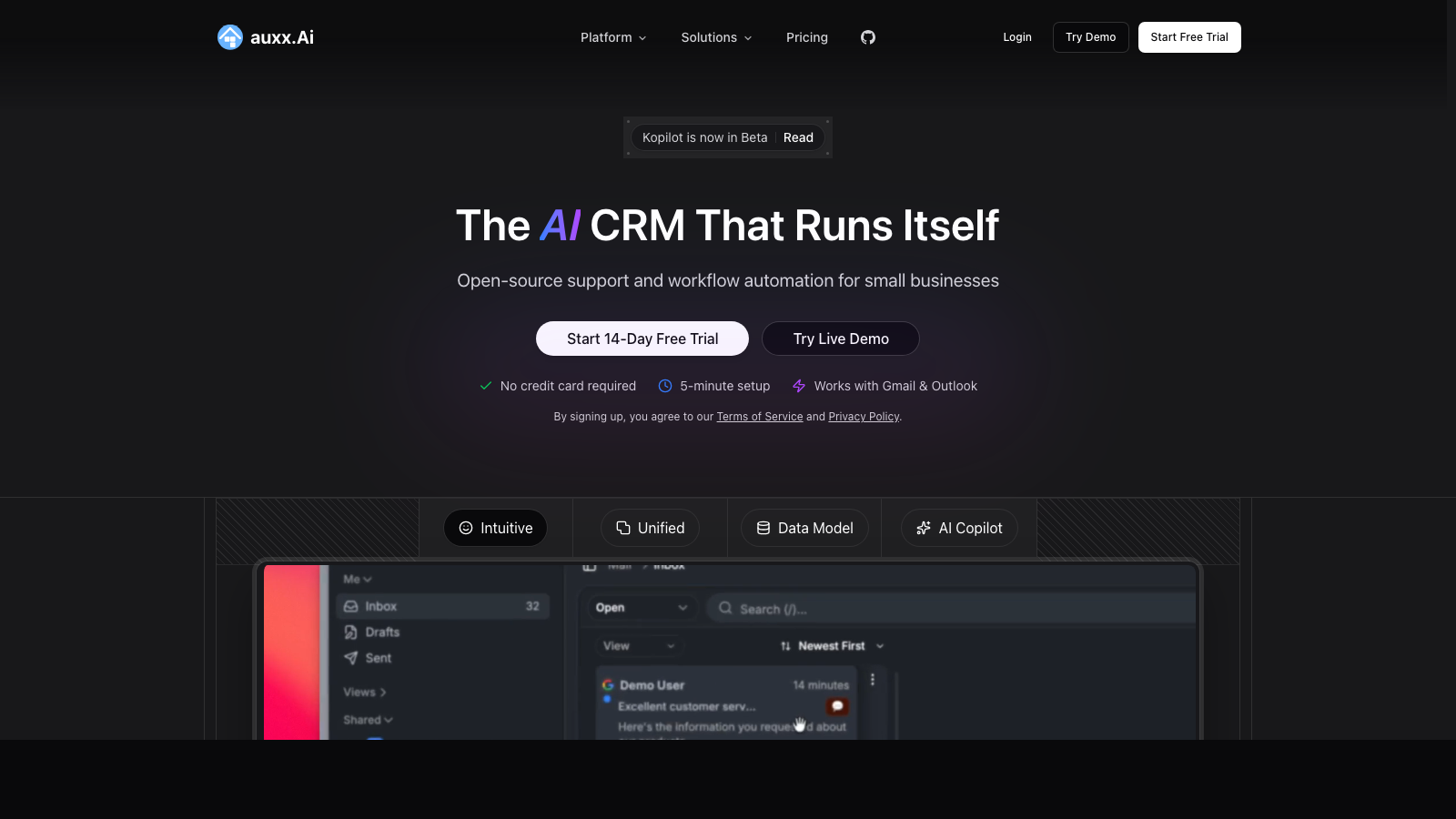
Auxx.ai is an open-source AI support CRM built for small businesses that want customer messages, tickets, workflows, and AI-assisted replies in one place. Its own positioning is direct: “The AI CRM That Runs Itself.”
That positioning is ambitious, so buyers should read it carefully. Auxx.ai is not trying to be a traditional sales CRM like Pipedrive or a full enterprise customer platform like Salesforce. It is closer to a support-first CRM that combines parts of a shared inbox, ticketing system, customer record, workflow builder, and AI copilot.
Auxx.ai at a glance #
| Category | Review |
|---|---|
| Best for | Small businesses with high support-message volume and basic CRM needs |
| Core use case | Organizing customer conversations, tickets, workflows, and AI-drafted replies |
| Standout angle | Open-source, AI-native support CRM with workflow automation |
| Main buyer | Ecommerce, service, or operations-heavy teams that live in email and support queues |
| Not ideal for | Teams that mainly need sales forecasting, territory management, or mature enterprise CRM controls |
| Pricing signal | Auxx promotes a 14-day free trial on its site; its own CRM tools article describes free self-hosting and a hosted plan starting at $19 per user per month |
Hacker News context #
Auxx.ai appeared on Hacker News as a Show HN post titled “Auxx.ai - Customer Support CRM (Mix of Attio and N8n)”. The launch post was written by Markus, who said he built it over 12 months to help his father’s business handle support messages, returns, product questions, and sales conversations.
That origin story matters because it explains the product shape. Auxx.ai is not framed as a generic CRM that later added AI. It was born from a support operations problem: too many messages, not enough structure, and no convenient way to keep customer history beside automation.
The HN item had 3 points and no visible comment thread when reviewed through the HN Algolia item API. So the HN source gives useful founder context, but not meaningful market validation or outside critique.
What Auxx.ai does #
Auxx.ai combines four product ideas:
- A CRM record for contacts, companies, and customer history
- A shared support inbox for customer conversations
- A ticketing system with priorities, statuses, assignment, and lifecycle tracking
- A workflow automation builder for routing, classifying, and responding to messages
The homepage emphasizes automated support workflows. Example workflows include receiving a customer message, classifying it as an order issue, return, or general question, routing it through conditional logic, drafting a reply with AI, and either sending the response or escalating it to a human agent.
The GitHub README describes Auxx.ai as an open-source AI-powered email support ticket service for Shopify businesses, with Gmail, Outlook, Shopify, AI response generation, workflow automation, a knowledge base, notifications, multi-tenant organization support, ticket management, and filtering/search.
Key features #
Unified customer context #
Auxx.ai is strongest when a business wants customer messages and customer data in the same workflow. Its public materials point to email, messaging apps, Shopify, support tickets, order context, contact records, and knowledge-base content as data sources that can help agents or AI understand what is happening.
This is useful for small businesses where the same customer may ask a product question, request a return, follow up on an order, and later become a sales opportunity.
AI-assisted replies #
Auxx.ai’s AI angle is not just generic chatbot copy. The product is positioned around replies grounded in business context, such as past conversations, order history, customer data, and knowledge-base information.
The HN launch post also says Auxx.ai supports AI-suggested replies, a conversational AI assistant, and bring-your-own AI provider keys. The GitHub README lists OpenAI, Anthropic, Google, and Groq among supported AI providers.
Workflow automation #
The workflow builder is the most important differentiator. Auxx.ai presents no-code automation for classifying messages, routing tickets, sending replies, requesting human review, making HTTP requests, creating records, updating data, and branching with IF/ELSE logic.
That makes Auxx.ai more interesting than a basic shared inbox. It is closer to a lightweight operations layer for support teams.
Ticketing #
Auxx.ai includes ticket lifecycle concepts such as priority, status, type, and assignment. That matters because small teams often start with email labels and eventually realize they need real ownership, queue visibility, and resolution tracking.
Open-source deployment #
The GitHub repository is public under an AGPL-3.0 license. It includes Docker setup, PostgreSQL, Redis, Next.js, tRPC, Drizzle ORM, TailwindCSS, and a multi-app monorepo structure.
Open source is a meaningful advantage for teams that care about self-hosting, data control, extensibility, or avoiding full dependency on a closed vendor.
Where Auxx.ai is strongest #
Auxx.ai is strongest for small businesses that have a support-heavy customer lifecycle.
Good-fit examples include:
- Ecommerce stores handling order questions, returns, and product inquiries
- Small service businesses receiving customer requests across email and messaging
- Teams that want a shared inbox but also need CRM context
- Businesses that want AI drafts without giving up human review
- Technical teams that like open-source software and may self-host
- Operators who want workflow automation but do not want to stitch together a CRM, helpdesk, and n8n-style automation stack
Auxx.ai is especially compelling if your current workflow is a messy combination of Gmail, Outlook, Shopify, spreadsheets, Airtable, and manual follow-up.
Where Auxx.ai may not fit #
Auxx.ai is not the obvious choice for every CRM buyer.
It may not be ideal if you need:
- Mature sales forecasting and quota management
- Complex territory management
- Advanced enterprise permissions and governance
- Deep marketing automation
- Large third-party marketplace maturity
- Established implementation partners
- A CRM with years of public customer reviews and benchmarks
The product is also young. The GitHub repository shows active development, but also a small public footprint: low star count, recent versions, and a launch-stage feel. That is not automatically negative, but buyers should treat Auxx.ai as an emerging product rather than a mature incumbent.
Auxx.ai vs traditional CRMs #
| Category | Auxx.ai | Traditional sales CRM |
|---|---|---|
| Primary orientation | Support, messaging, workflow automation | Deals, pipeline, forecasting, sales activity |
| AI role | Draft replies, classify, assist, automate support workflows | Lead scoring, forecasting, summaries, sales assistance |
| Best customer record | Customer messages, support history, order context | Contacts, accounts, opportunities, sales history |
| Workflow style | No-code routing and automation around tickets/messages | Sales process automation and pipeline movement |
| Buyer profile | Small support-heavy teams | Sales-led teams |
The practical takeaway: Auxx.ai should be compared less against classic sales CRMs and more against shared inboxes, helpdesks, workflow automation tools, and AI support platforms.
Verdict #
Auxx.ai is a promising AI support CRM for small businesses that need to organize customer messages and automate support workflows. Its strongest idea is combining customer context, ticketing, AI replies, and workflow automation in one open-source product.
The best buyers are support-heavy small businesses, especially ecommerce or service teams that are outgrowing inbox-based support. The less ideal buyers are sales-led teams that need mature pipeline management, forecasting, and enterprise CRM controls.
Auxx.ai is worth testing if your pain is: “We have too many customer messages, too much context switching, and not enough automation.” It is less compelling if your pain is: “We need a classic sales CRM to manage opportunities, reps, targets, and forecasts.”
FAQ #
Is Auxx.ai a CRM or a helpdesk? #
Auxx.ai sits between the two. It has CRM records for customer context, but its strongest public positioning is support workflow automation, shared inbox, ticketing, and AI-assisted replies.
Is Auxx.ai open source? #
Yes. Auxx.ai has a public GitHub repository under an AGPL-3.0 license.
Who should use Auxx.ai? #
Auxx.ai is best for small businesses that manage many customer messages and want AI-assisted replies, workflow automation, ticketing, and customer context in one system.
Is Auxx.ai a replacement for Salesforce or HubSpot? #
Usually no. Auxx.ai is not positioned as a full enterprise CRM or broad marketing platform. It is more relevant as a support-first CRM for small teams.
What is the biggest risk with Auxx.ai? #
The biggest risk is maturity. Auxx.ai appears young, so buyers should test reliability, integrations, data export, permissions, reporting, and support before relying on it as a core customer system.